

Why are some wheat cultivars more susceptible to powdery mildew (Blumeria graminis f. sp. tritici)? Which regions of the wheat genome provide better powdery mildew resistance? Can we predict wheat powdery mildew resistance by studying the genetic composition of the plant? Researchers from Norway, Estonia, Lithuania, and Latvia wanted to get answers to these questions in a study carried out as part of the NOBALwheat project.
Plant disease can lead to unrealized yield potential
Yield stability is an essential characteristic of a cultivar. But even under optimal growing conditions, wheat cultivars may fail to reach their true yield potential due to fungal diseases. Yield losses caused by plant diseases to wheat growers mean additional costs of plant protection on top of the already expensive field works and fertilization. This raises an important question - how can we avoid it? The aim of the three-year NOBALwheat project was to investigate the genetic basis of essential adaptation traits, including disease resistance, in Nordic and Baltic spring wheat.
Wheat powdery mildew affected plants in all trials.
Wheat disease resistance trials were conducted in Norway, Estonia, Lithuania, and Latvia on micro plots of up to one square meter in size, containing at least 20 plants each. Such an experimental design made it possible to assess the incidence and development of diseases at several points in time on hundreds of plots during the entire season. Field trials included a panel of 300 wheat lines, including cultivars adapted to our region and breeding lines of different origins.

Nordic and Baltic spring wheat trial for disease assessment. Photo by Bulat Islamov
The growing conditions and disease pressure of the four countries are different. Wheat powdery mildew affected plants in all trials. However, the infection level of the lines was different, meaning there was high variability in the resistance to powdery mildew in the wheat panel. The variability of disease resistance is associated with the genetic variability of the panel. The genetic composition of a plant determines if it gets affected by the disease, to what extent, and at which growth stage.
Genome-wide association analysis showed that specific regions in the wheat genome affect the powdery mildew resistance. The region of the wheat chromosome 3A significantly affects powdery mildew resistance in the field. The region has two variants: "resistant" 3A and "susceptible" 3A. The "resistant" variant was present in the majority of NOBALwheat wheat lines (87.1%) and was associated with a lower disease severity compared to the wheat with the "susceptible" variant.
Disease resistance genes protect plants differently depending on the growth stage
Some genes provide disease resistance from the plant's first leaf stage and up to the flag leaf stage. Other genes provide disease protection only at late stages of plant development. The next step of the study was to find out whether the "resistant" 3A variant also provides seedling resistance.
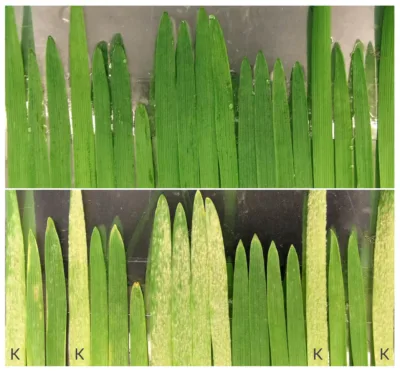
At the Centre of Estonian Rural Research and Knowledge, wheat seedlings were infected with several powdery mildew isolates. Consequently, no specific pattern was found that could be associated with the "resistant" 3A variant. Therefore, it can be concluded that the "resistant" 3A variant provides resistance to adult plants, meaning it protects plants in a growth stage-dependent manner.
In other words, some wheat varieties are susceptible to powdery mildew as seedlings, and only later in development can they counter the disease. This makes breeding varieties less prone to disease throughout the growing season.
For example, the cultivar 'Spécifik,' common in Estonia, is resistant to specific powdery mildew isolates but is infected by others at the seedling stage. This cultivar has the 'susceptible' 3A variant, and the plant is also affected by powdery mildew at later stages of growth. In comparison, the line 'Saar' from Mexico is susceptible to all isolates as a seedling. Still, later in development, it is less affected by the disease due to protection by the "resistant" 3A variant. In contrast, the wheat cultivar 'Mooni' has neither seedling nor adult plant resistance and is severely affected by the disease.
A good opportunity for breeders and hope for wheat growers
The study explored the genetic diversity underlying the powdery mildew resistance in elite wheat adapted for the Nordic and Baltic regions.
Based on the results, wheat breeders can design crossing schemes to combine multiple "resistant" genome regions, using marker-assisted techniques, to improve powdery mildew resistance. Wheat growers prefer wheat that produces stable, high yields and is resilient to diseases and adverse weather events.
A much wider choice of cultivars with improved resistance to powdery mildew and reduced need for plant protection will be available for farmers. It means a safer food supply with a smaller environmental footprint for consumers.
For more details on the results of the study, see the article published in the journal Theoretical and Applied Genetics, "Genome-wide association analysis identifies a consistent QTL for powdery mildew resistance on chromosome 3A in Nordic and Baltic spring wheat".
Author:

Bulat Islamov
Department of Plant Protection
Junior Research Fellow

