
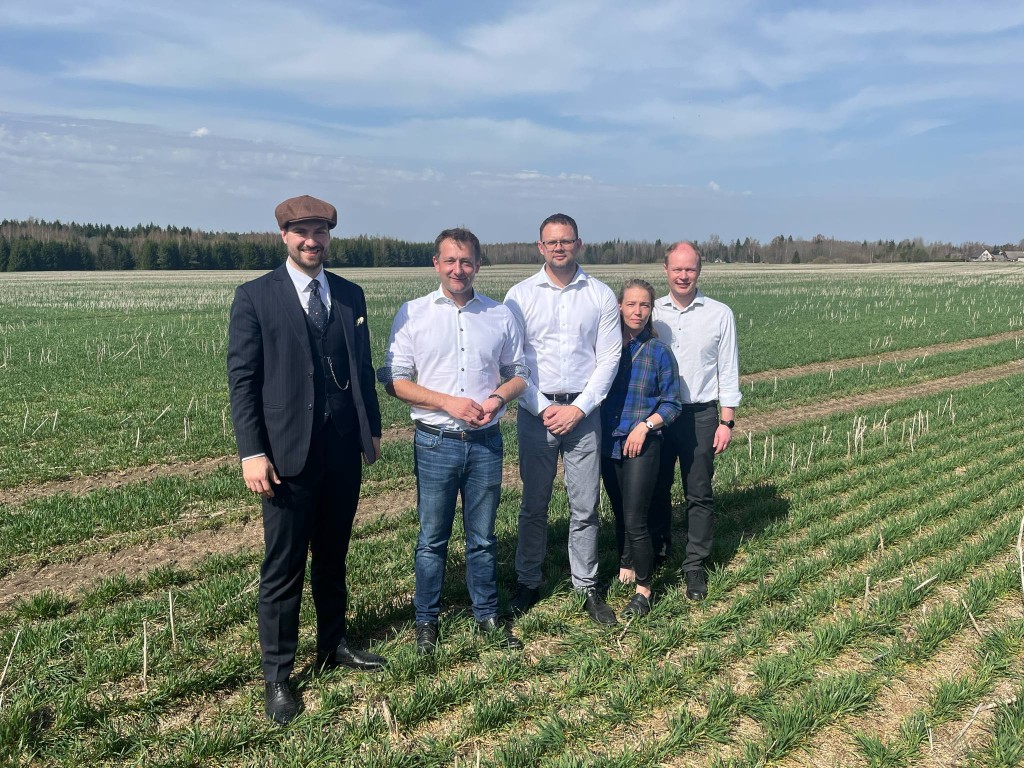
The highlight of the day was a roundtable discussion focusing on the progress made in the digitalisation of Estonian agriculture, cooperation between the private and public sector, and future directions in the development of sustainable and data-driven agriculture.
The Centre of Estonian Rural Research and Knowledge’s Contribution to the Development of the Agri-Food Sector
In his presentation, Andre Veskioja, Director of the Centre of Estonian Rural Research and Knowledge, emphasized that the organisation’s mission is to support rural Estonia through science-based applied knowledge, services, and networking. Among other responsibilities, the Centre coordinates the Agricultural Knowledge Transfer and Innovation System (AKIS) and actively contributes to the supporting ecosystem for innovation and greening.
Private Sector Innovation: eAgronom
Robin Saluoks, founder and the CEO of eAgronom, presented Estonia’s digital farming success story, noting that the country has one of the highest levels of adoption of digital farming solutions in Europe. Farms using the eAgronom platform manage around 50% of Estonia’s arable land. The company also develops carbon farming programmes and cooperation models with banks and the food industry, enabling farms to earn additional income through sustainable practices.
PRIA’s Role in Digitisation
Kadri Koel and Rando Undrus presented the key pillars of the Estonian Agricultural Registers and Information Board’s (ARIB) new strategy: data sharing, transforming data into useful information, transparency, and reducing administrative burden.
Examples include pre-filled payment applications, a remote sensing-based control system, geotagged photo applications, AI-based photo verificati. ARIB aims to move towards application-free subsidies and zero bureaucracy.
Sadala Agro’s Experience
Martin Maante, representing Sadala Agro, emphasized that the success of large farms depends on data-driven decisions and automated workflows.
The company uses a range of digital tools to manage working hours, machinery, and fertiliser logistics. It has also implemented a pest detection system capable of identifying pest species and abundance in real time. This innovation was driven by a real-life challenge: last year, pests caused extensive damage to oilseed rape crops.
Focus: Forward-Looking Issues
The discussion touched on the need for a more robust system of recommendations for organic fertiliser use, moving beyond calendar-based restrictions toward a location-specific approach based on soil analysis and weather data. There was also discussion on the need for more flexible rules regarding the age of grassland in crop rotations.
The Commissioner, in turn, raised the importance of developing the bioeconomy, including value chains for hemp and forestry, where farms also have a key role. He was also interested in how Estonian farmers assess carbon credit schemes and their views on potential future nature credit systems.
Summary
The Commissioner’s visit underscored the strong potential of Estonian agriculture and its readiness to lead the digitalisation and sustainability trends in Europe. The ideas, experiences, and solutions shared during the visit confirmed that Estonian farms are advancing toward the future in a knowledge-based, smart, and coordinated way.

